Project Detail: Brick Prison
Contest:
Black and White 2026
Brand:
Fotocontest.it
Author:
Alain Schroeder
Project Info
Brick Prison
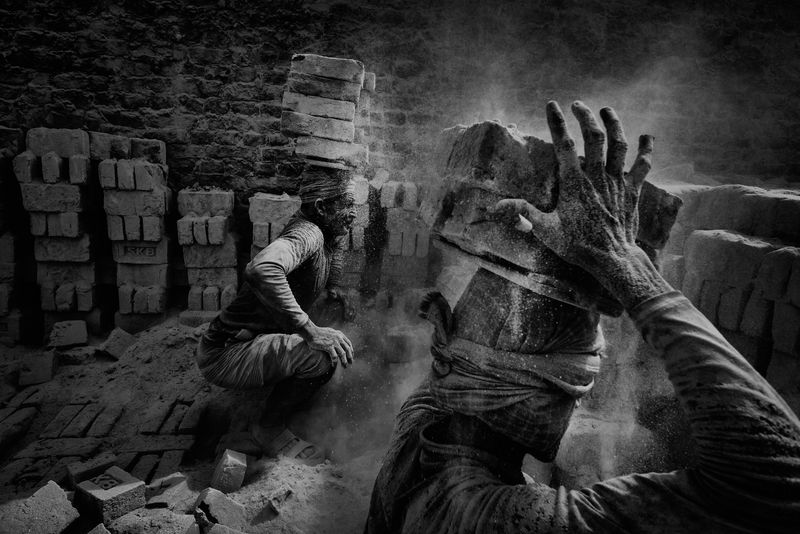
The technique of collecting bricks is well established. The men crouch down and using both hands, simultaneously place two bricks on a flat piece of wood resting on their head.
Bangladesh,
The technique of collecting bricks is well established. The men crouch down and using both hands, simultaneously place two bricks on a flat piece of wood resting on their head. But every movement stirs up a fine cloud of dust that covers them completely as it settles, transforming them into earth statues and endangering their health.
20 km east of Dacca, the periphery reveals many brick factories where men, women and very often children work in difficult and dangerous conditions.
In this industrial complex, men prepare the earth using a mold to make bricks of gray color. After drying in the sun, they will go into a giant oven; a sort of long tunnel similar to those of coal mines.
Overwhelmed with dust, in an infernal heat, women and children carry the bricks outside in wheelbarrows.
With about 11,000 brickworks across the country, Bangladesh is struggling to meet the construction demands of a rapidly growing population. Armies of workers including women and children suffer the hard manual labor, in extremely poor conditions, for merely $1 per day. Working 12-18 hours, without access to fresh water or decent food, children as young as 4 contribute to the monumental task of producing 1500 bricks per person per day. Families live in makeshift camps near the factories breathing air filled with arsenic and particles of burnt plastic. Despite the 2011 directives from the OECD and the UN, holding multinationals accountable for workers rights and good labor practices all along the manufacturing chain, the reality on the ground is rather substandard.
Several associations have launched campaigns under the name “Blood Bricks”, to heighten awareness around what is essentially a form of slave labor. Particularly active in India, unions, ONGs and other human rights organizations are staging events to inform local populations and mobilize workers in order to improve working conditions, increase pay rates and above all, eliminate child labor which leaves kids uneducated, exploited and trapped in poverty.
Photos